
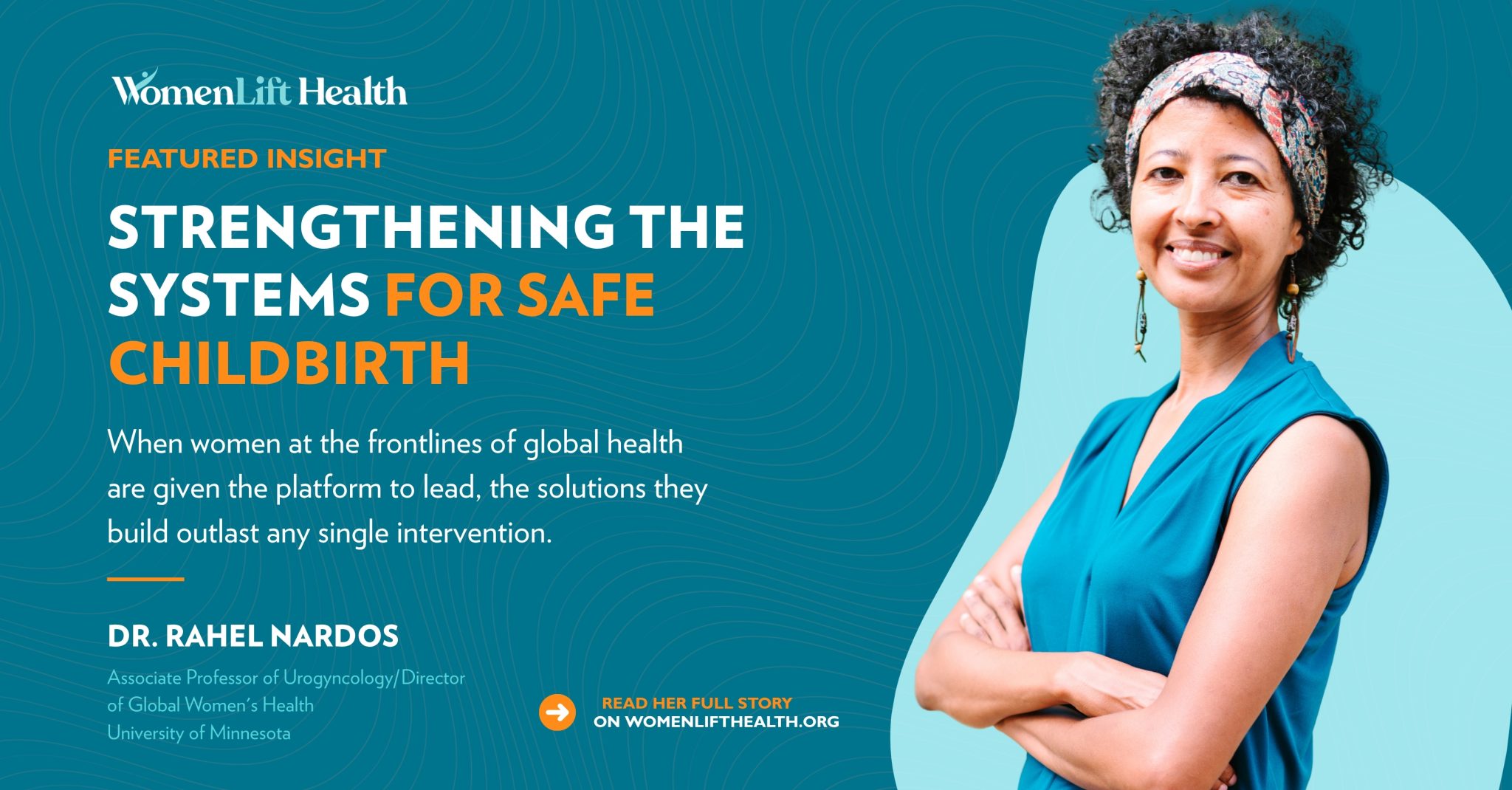
A woman dies every two minutes from childbirth complications, with 95% of those deaths occurring in low- and middle-income countries (LMICs). For every death, many more women suffer lasting injuries, often due to gaps in access to safe surgical care. Dr. Rahel Nardos is building the training platforms, systems, and local expertise to close that gap.
As a urogynecologist and Director of Global Women’s Health at the University of Minnesota, Rahel splits her time between clinical practice in the US and training and capacity building with partners in Ethiopia, Rwanda, and Botswana. Across these contexts, her focus is on building local capacity. Early in her career she realized that flying in surgical teams was not sustainable, when the team left, so did the expertise. This led her to help establish the first urogynecology fellowship training program in Ethiopia, in partnership with Hamlin Obstetric Fistula Hospital, Mekelle University and Worldwide Fistula Fund. Over the past ten years, the program has trained seven fellows, two of whom now lead it themselves. When war tore through the Tigray region and her team couldn’t travel, the local surgeons kept going. “That’s why I really care about local capacity building,” she says. “You get yourself out of the job, if you’re successful.”
That same philosophy drives her other initiatives. During her WomenLift Health Leadership Journey, Rahel used her leadership project to develop safe cesarean delivery simulation-based e-learning modules for healthcare providers, with partners in Ethiopia and Rwanda- focused on team communication, informed consent, and shared decision-making in low-resource settings. Cesarean deliveries are the number one most commonly done surgeries globally with related mortality and morbidity up to 100 times higher in LMICs. The modules address a critical gap: nearly 80% of major medical complications stem from poor communication, not poor technical skill. Now hosted on the UN Global Surgery Learning Hub and accessible to providers globally, they offer a more equitable way to share training resources at scale.
For Rahel, the WomenLift Health Leadership Journey wasn’t just a leadership growth opportunity as she builds out this platform – it introduced her to a community of mid-career women working at the intersection of global health and leadership. “In academia, I don’t always run into people who do what I do,” she reflects. “To be a part of that community … It’s just invaluable.” The connections she built continue to be a source of ideas, collaboration, and mutual support.